
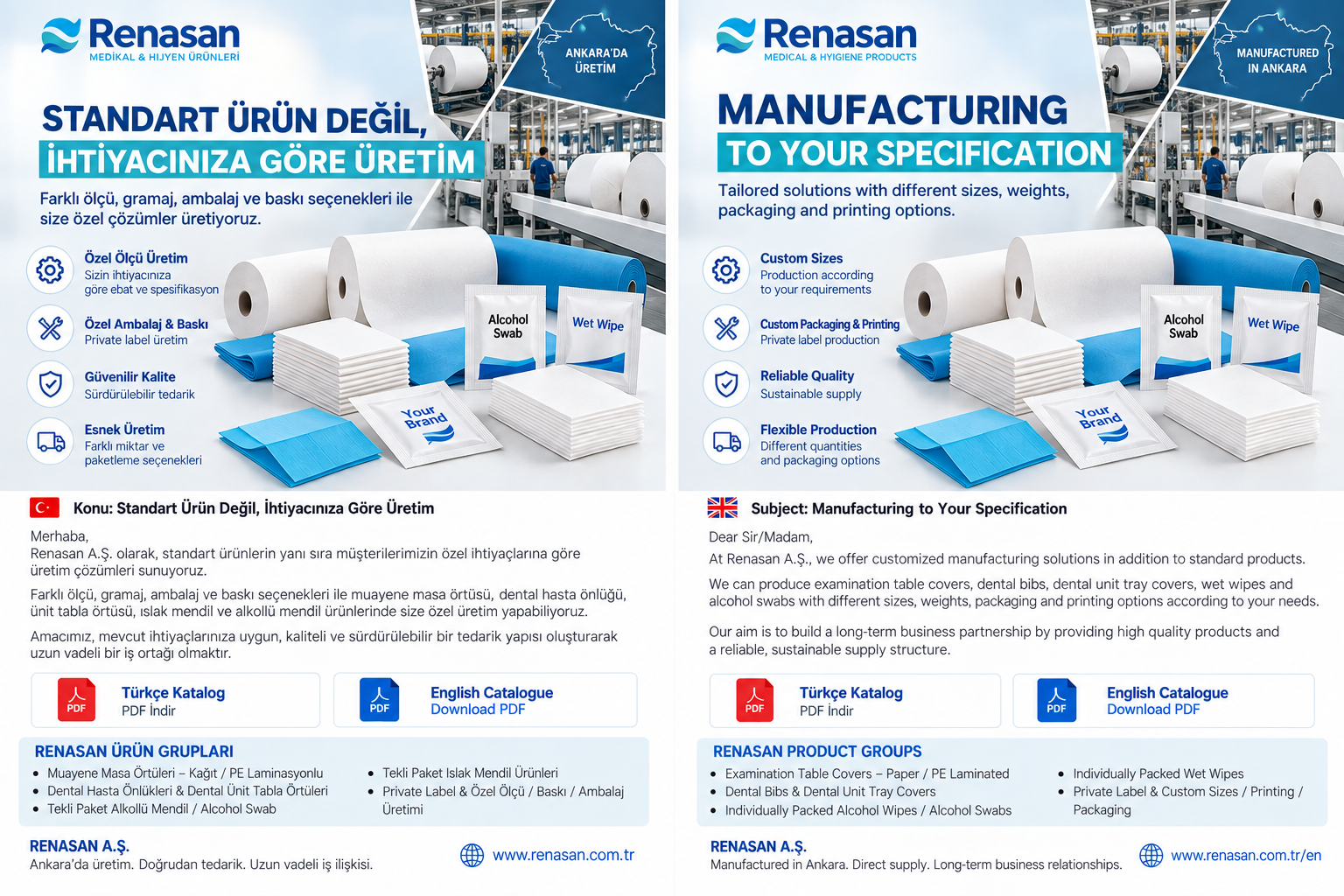
Not every purchasing requirement fits a standard product. Dimensions, packaging, printing and presentation may vary depending on your market, customer or application.
RENASAN manufactures at its own production facility in Ankara, Türkiye, and evaluates custom requirements within its existing product groups and production capabilities.
If your requirement differs from a standard product, you can discuss it directly with the manufacturer.
What can you specify?
Share the required product, dimensions, approximate quantities and any special packaging, printing or private label requirements. If the request is suitable for our production capabilities, we will be pleased to evaluate the available manufacturing options.
Our aim is not only to supply standard items, but also to assess practical manufacturing solutions for recurring customer requirements.
RENASAN product groups
- Examination table covers – paper and PE laminated
- Dental bibs and dental unit tray covers
- Individually packed alcohol wipes and alcohol swabs
- Individually packed wet wipes
- Custom sizes, printing, packaging and private label options
Send us your specification
For custom sizes, packaging, printing and private label requirements, contact RENASAN directly at the production source. Tell us what you need so we can evaluate manufacturing feasibility together.
RENASAN website | English product catalogue
RENASAN A.Ş. — Manufactured in Ankara. Flexible production. Direct supply.
Custom manufacturing compared with a standard product
A standard product is supplied according to an existing combination of dimensions, materials and packaging. Custom manufacturing considers changes to one or more of those characteristics to meet a particular buyer’s requirements. Not every proposed change is technically feasible, however. Production equipment, material availability, printing arrangements, order volume and lead times all need to be considered together.
Begin by explaining the problem the requested change is intended to solve. Is a different roll width needed? Does the current carton arrangement create storage difficulties? Is a brand-specific print or different pack quantity required? Clearly identifying the parameters to be changed helps both the buyer and manufacturer evaluate realistic options.
Start with a technical requirements document
Describe the intended application, dimensions, material construction, expected function and packaging in one shared record. If modifying an existing item, list the old and new values. Product codes, drawings, sample references, authorized tolerances and artwork versions may also be important depending on the project. Critical technical details should be confirmed rather than assumed.
Different products need different fields. An examination table roll may be defined by width, length and perforation spacing. A dental bib may require dimensions and a clear material-layer description. A single packed wipe or sachet project may involve the formulation type, net fill, packaging film and printing layout. These specifications should be reviewed together rather than in isolation.
Examples of configurable requirements
| Area | Example request | Feasibility consideration |
|---|---|---|
| Dimensions | Different width, length or roll format | Equipment and material suitability |
| Packaging | Different units per pack or carton | Line and warehouse arrangements |
| Printing | Brand-specific artwork or language | Approved files and print setup |
| Materials | Different layers or construction | Functional requirements and supply |
| Delivery | Staged shipments | Production schedule and inventory planning |
These examples are not a claim that every configuration is currently available. Each request must be evaluated against the actual product and manufacturing conditions.
Why minimum order quantities may change
Custom dimensions and printing may require dedicated preparation, material sourcing or equipment adjustments. Certain packaging formats can also have their own supplier minimums. As a result, a quantity appropriate for a standard item may be different for a custom configuration. Sharing expected volume and the likelihood of repeat orders can help the manufacturer assess suitable alternatives.
Ordering more units solely to reduce the unit price can create unnecessary inventory. Storage capacity, expected consumption and the time items may remain in stock should also be considered. For recurring consumables, the principles in our reorder-point and safety-stock guide can help support purchasing plans.
Samples, approval and production
A representative sample may be useful for a new configuration. Review it against the stated requirements rather than relying only on photographs. Depending on the application, checks might include dimensions, material behavior, opening performance or ease of use. Any technical tests or quality activities needed for the product must be handled separately. Identify the approved sample by reference and revision before regular production begins.
Our guide to specification and revision control explains why the agreed product definition must remain stable. If a repeat order changes materials, artwork or pack quantities, the update should be explicit and approved by the relevant parties.
Private label artwork and responsibilities
Private label work adds brand names, graphic files, packaging copy and product details to the technical requirements. Approve final artwork versions and establish contractual responsibilities for brand rights, product information and applicable labeling compliance. Attractive graphic design alone does not establish that the required product information is correct.
Markets may have different language and labeling needs. These should be assessed before printing begins. Individually packed consumables often have limited printable space, so layout design and required information must be planned together.
Quotations and realistic delivery planning
Custom-manufacturing quotations may include costs beyond those associated with a standard item, such as special materials, print setup, sampling, machine preparation or packaging development. Distinguish these elements where relevant. The approval timeline must also be separated from the production timeline; an unapproved artwork file should not be treated as a completed pre-production milestone.
For repeat projects, store the approved product code, technical form and artwork version together. This allows later orders to use a consistent reference rather than reconstructing requirements from old messages.
A request checklist
- Identify the product category and intended application.
- Provide an existing reference or sample when available.
- Specify proposed changes to dimensions, materials, printing and packaging.
- State approximate quantities and whether the demand will recur.
- Clarify sample approval and quality expectations.
- Provide delivery location, target timing and language requirements.
Frequently asked questions
Can every standard product be made in a custom size?
No. Feasibility depends on the construction, equipment, materials, quantity and production process.
What artwork is required for private label printing?
Approved graphic files, text and production-specific print information may be needed. The required file format depends on the packaging and printing process.
Does every repeat order require a fresh sample?
Existing approvals may be reused when the specification remains unchanged. Material changes may need a new technical review or sample approval.
Conclusion: The value of custom manufacturing lies in defining a product around a real requirement, then evaluating the feasibility and approval process openly. Clear technical information turns a special request into a manageable production project.