
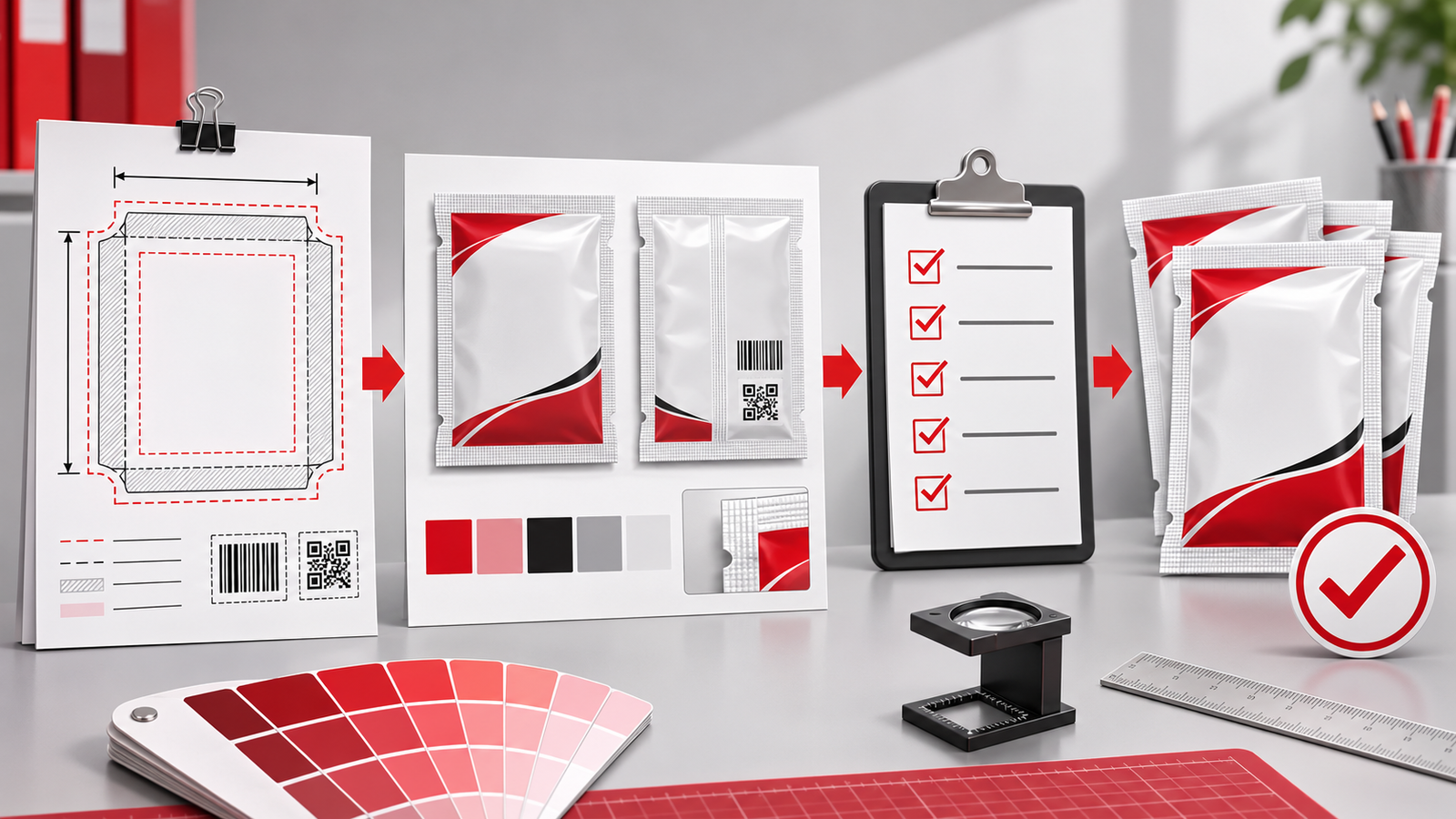
Private label wet wipe packaging artwork is more than placing a logo on a sachet. Finished dimensions, print route, cut and seal zones, legibility, variable data fields and the approved revision must all belong to the same production record. An artwork approval issued without those controls can lead to avoidable revisions after printing has started or to packaging that differs from the brand’s expectation.
This guide does not repeat the broader sourcing decisions covered in our private label wet wipes buying guide. It focuses specifically on the pre-production approval of packaging artwork.
Why should the pack format be fixed before design begins?
The same artwork should not simply be enlarged or reduced for another sachet size. When width and height change, the logo scale, line breaks, barcode area and safe distance from cut and seal zones change as well. The format should be agreed first and the artwork built on the project-specific technical template.
RENASAN’s verified single-sachet wet wipe options include 6 × 8, 7 × 10 and 7 × 12.5 cm formats. The published 7 × 10 cm product specification states a 70 × 100 mm outer pack, a 20 × 13 cm inner sheet, coated/triplex/metallised wrapper alternatives, customer-specific logo printing and up to three-colour flexographic or image printing. These details must not be transferred automatically to another format or project; each quotation should carry its own technical record.
Information to settle before artwork starts
Finished dimensions and orientation
Width, height, front/back orientation and how the sachet will be presented should be recorded. Portrait or landscape presentation affects the placement of the brand name, product name, opening direction and required text.
Wrapper material and print route
Coated, triplex and metallised surfaces can reproduce the same colour differently. Solid corporate colours and artwork containing photographs, gradients or many colours may require different print routes. The selected material and print method should be stated on the proof being approved.
Fixed and variable information matrix
Separate the brand, product name and fixed usage text from batch, manufacturing date, expiry date or coding fields. The position of variable information and how it will be applied in production should be decided during artwork preparation. Required fields depend on product classification and target market.
Destination market and language
For retail or export projects, label language, importer/responsible-party details, ingredients and warnings should be prepared for the destination market. A manufacturing option from RENASAN does not replace the brand owner’s regulatory responsibilities; final copy should be verified with the competent authority or a qualified adviser.
Eight checks before print approval
- Technical template: Confirm that the artwork uses the correct finished dimensions and project-specific cut and seal zones.
- Safe area: Keep logos, small text, barcodes and QR codes away from cut and sealing areas.
- Legibility: Review long copy at actual pack size, not only on a zoomed-in screen.
- Colour definition: Record corporate colour references and the selected print route on the approval form.
- Artwork quality: Supply the logo and images in the production file format accepted for the project; do not use a screenshot as the master artwork.
- Code areas: Show barcode, QR and variable-code positions with sample data and plan an appropriate readability check.
- Language and claims: Do not add “antibacterial”, “disinfecting” or similar claims without confirming the resulting classification and regulatory requirements.
- Revision record: Put the date, version and approving party on the final file; do not allow older email attachments to become the production master.
What does a digital proof confirm—and what does it not?
A digital proof is the key record for layout, text, orientation, dimensions and revision. It does not, by itself, guarantee that screen colours will match the selected wrapper material. Where colour accuracy is critical, evaluate the print method and wrapper through a physical sample or the proofing route recommended for the project.
Likewise, the presence of a barcode in the file does not prove that it will scan under every condition. Size, contrast, print direction, surface and placement should be considered together.
How should changes after approval be controlled?
If pack dimensions, wrapper material, product name, language, barcode or print route changes, the old approval should not automatically remain valid. Separate simple copy corrections from revisions that affect the technical template.
| Change | Required check | Record |
|---|---|---|
| Copy or language | Legibility, compliance, line breaks | New proof and revision |
| Pack dimensions | New template and safe areas | New dimensioned file |
| Wrapper material | Print route and colour appearance | Material/print approval |
| Barcode or QR | Size, contrast, direction and sample scan | Code version and test record |
What should you send when requesting a RENASAN quotation?
- Selected sachet dimensions and wrapper option
- Logo and images in the production artwork format accepted for the project
- Fixed front and back copy
- Variable fields such as batch/date/coding areas
- Corporate colour references and preferred print route
- Destination country, label language and use case
- Total quantity, carton plan and delivery expectations
Review RENASAN’s verified options in the private label wet wipes guide, the manufacturing-to-specification article and the 2026 English catalogue. Cosmetic sachet projects use a related but different artwork flow; see the sachet packaging artwork checklist.
If your artwork and specification are ready, contact RENASAN for project-specific feasibility and quotation review. For more procurement guidance, visit the English articles archive.
Frequently asked questions
Is a PDF approval alone sufficient for wet wipe packaging?
It is the core record for layout and copy, but a project may also need a physical proof or sample where colour, wrapper appearance or code readability is critical.
Can artwork from an earlier order be used for a new sachet size?
Not without a new check. Cut, seal and safe design zones change with pack dimensions, so the artwork should be rebuilt or revalidated on the correct technical template.
Can a corporate colour be selected from a screenshot?
A screenshot is not a reliable colour standard. Record the approved colour reference, print route and wrapper surface, then approve the result through the proofing method selected for the project.
Who should verify barcode and QR codes?
The brand should verify code content; design and production teams should check placement and printability; the brand or its authorised party should verify readability on the relevant sample.