
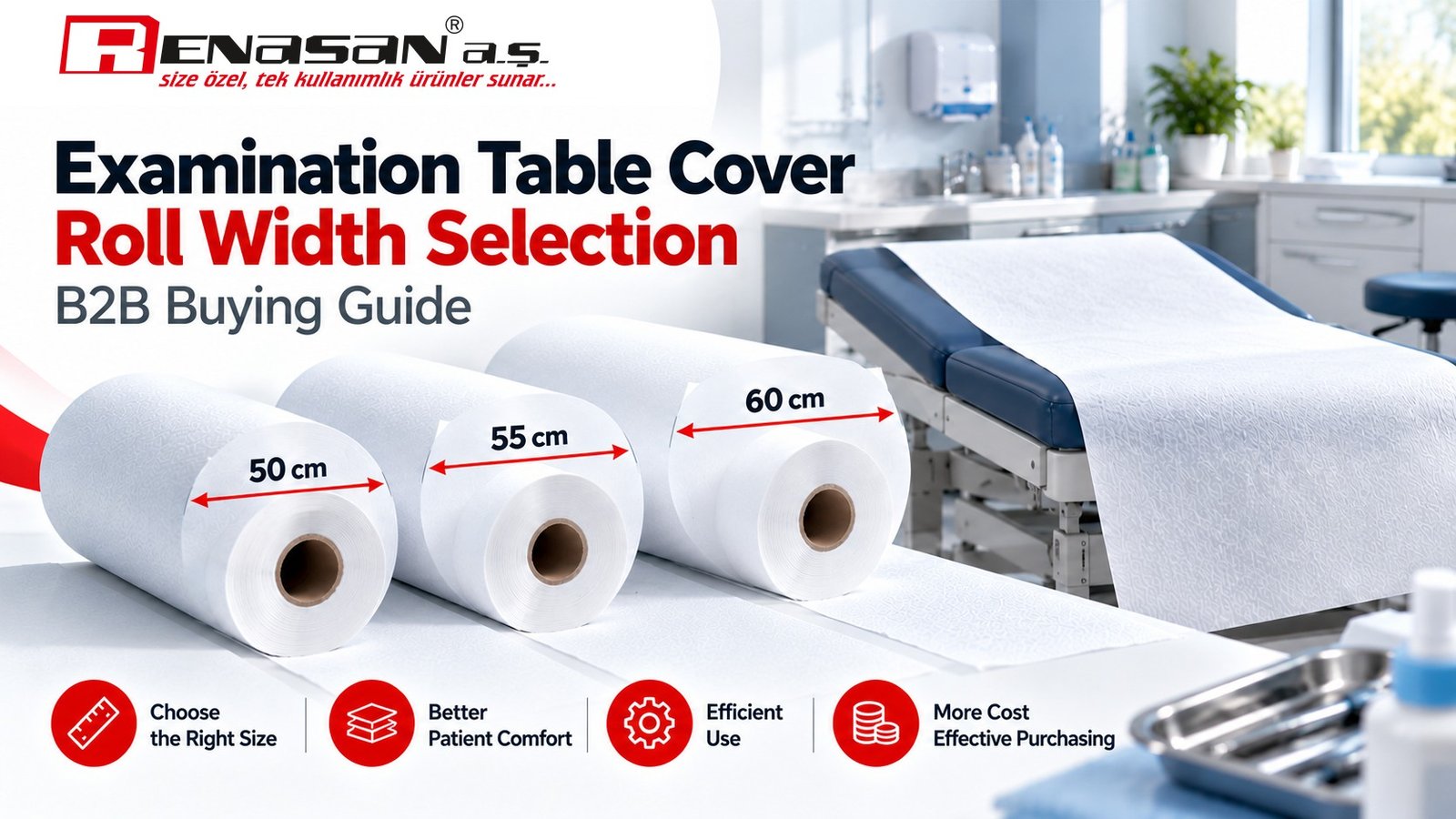
Specifying only “examination table cover roll” is not enough for a reliable B2B quotation. Roll width should be assessed together with the actual usable table surface, required edge allowance, roll-holder or dispenser dimensions, and packaging expectations. A technically acceptable product may still create excessive overhang, insufficient coverage or equipment incompatibility if the width is not defined correctly.
Roll-width decision path
Record the surface that must actually be covered.
Assess overhang and uncovered-area risks.
Confirm spindle length and maximum roll width.
State width, roll length, perforation and carton plan together.
Why is roll width a procurement criterion?
Roll width defines the horizontal area covered on an examination table or couch. The decision should not rely only on the table’s outside dimensions. The intended contact area, accessories, the position of the roll holder and the way staff place the cover can all affect the result.
A roll in the nominal 50 cm class and a 55 cm roll create different edge allowances on the same table. Whether that difference is useful or unnecessary must be established at the point of use. The purchasing specification should state the nominal width and any accepted tolerance instead of using a vague description such as “approximately 50 cm”.
How should the table and equipment be measured?
Measure the usable surface
Record the flat area that the product will actually cover, not only the table’s external width. Side rails, head sections, attachments and curved edges may change the usable surface. If several table models are in service, document both the narrowest and widest models.
Verify roll-holder and dispenser compatibility
Where a dispenser is used, check the spindle length, the clearance between side panels and the space required for the roll to rotate freely. A suitable nominal width may still bind inside the holder. Add “maximum dispenser roll width” to the specification as a separate field.
Define edge allowance by use case
A wider roll is not automatically the better option. Excessive overhang may make placement inconvenient, while a narrow roll may leave the target area uncovered. During sample approval, record the installed product with both a photograph and measurements.
Roll width, perforation and roll length are different specifications
Roll width is the horizontal measurement. The perforation interval defines the length of each detachable sheet, while roll length is the total material length. Two rolls of the same width may therefore provide different numbers of uses when their perforation intervals differ. Show all three values in separate columns when comparing quotations.
For a deeper explanation, see examination table cover perforation and number of uses.
Select lamination separately from roll width
In a laminated structure, the upper paper layer provides absorbency while the lower polyethylene layer helps limit liquid transfer. Absorbency and liquid barrier are not the same property. A non-laminated product does not contain this barrier layer. The material structure should therefore be selected according to the application and expected liquid contact, not by width alone.
See the available structure and format information on the laminated examination table cover page.
How should 50 cm and 55 cm options be compared?
| Decision area | 50 cm class | 55 cm class |
|---|---|---|
| Table fit | May suit a narrower usable surface | May suit a wider surface or additional edge allowance |
| Dispenser | Existing holder dimensions must be verified | Side clearance and spindle length require particular attention |
| Packaging | Units per carton must be confirmed against the final roll specification | Carton and pallet planning must be confirmed separately |
| Quotation comparison | State width, roll length and perforation together | State width, roll length and perforation together |
This comparison does not mean that one width is universally better. The correct option is the one that matches the measured application and logistics plan.
What should a quotation request include?
- Nominal roll width and accepted tolerance
- Total roll length
- Perforation interval or target sheet length
- Laminated or non-laminated construction
- Printing and label requirements
- Maximum roll dimensions accepted by the holder or dispenser
- Expected pack and carton configuration
- Pallet, warehouse and transport constraints
Providing these fields in one technical file makes it easier to compare supplier quotations against the same product definition.
How should sample approval be recorded?
Do not approve the sample by appearance alone. Record roll width, roll length, perforation, material structure, packaging and label information together. Repeat orders should use the same product code and revision; any dimensional change should be managed as a new revision.
Frequently asked questions
Must the cover width equal the table width?
Not necessarily. The usable surface, required edge allowance and dispenser dimensions should be assessed together.
Can 50 cm and 55 cm rolls use the same dispenser?
Do not assume compatibility. Measure spindle length and side clearance and verify physical fit for both widths.
Does the perforation interval change roll width?
No. Perforation defines sheet length; roll width defines horizontal coverage. They are separate specifications.
Are units per carton determined only by roll width?
No. Roll length, roll diameter, material construction and the packaging plan also affect carton configuration and must be confirmed before ordering.
Define your technical order file with Renasan
Share the table dimensions, roll width, roll length, perforation and packaging expectations in one file. RENASAN can evaluate the request from both production and shipping perspectives. Contact RENASAN.