
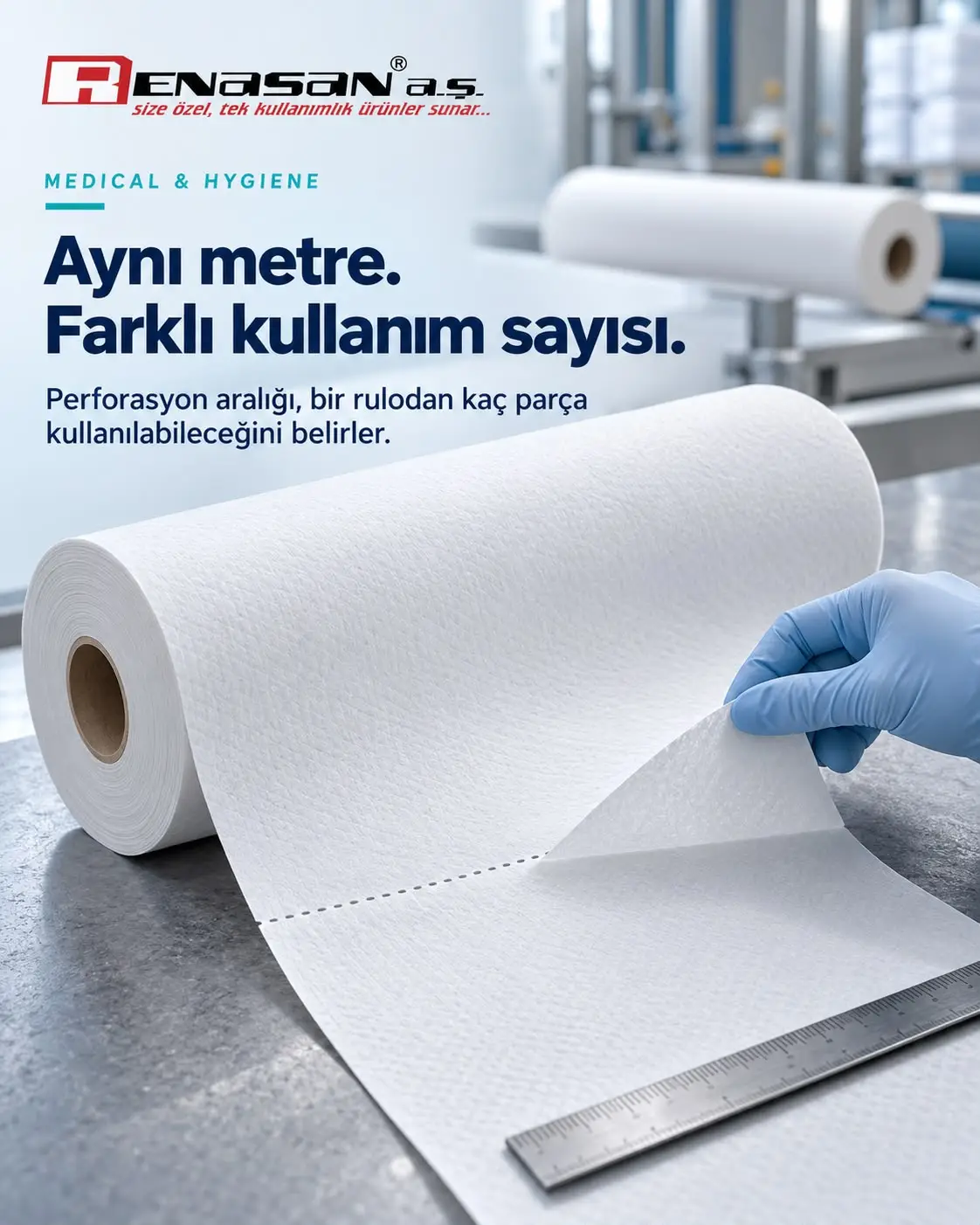
Two examination table cover rolls of the same length may not provide the same number of uses.
How does perforation spacing affect the number of uses?
The theoretical number of sheets available from a roll is determined by dividing the total roll length by the perforation spacing. Shorter perforation spacing increases the number of sheets; however, this does not always mean better value.
If a sheet is too short for the area being covered, a second sheet may be needed. If it is longer than necessary, excess material may be consumed with each use. The right perforation spacing should therefore be assessed together with the table dimensions and how the cover is used.
Four criteria when purchasing examination table covers
When purchasing examination table covers, do not compare only the roll price and total length:
- Roll width
- Total length
- Perforation spacing
- Number of usable sheets per roll
These four details provide a more accurate picture of the actual cost per use.
The same length does not always mean the same efficiency.
Roll length alone does not determine the number of uses
Total length matters when buying an examination table cover roll, but it does not fully explain actual consumption. Perforation spacing defines the length of each detachable section. The amount of material needed to cover a table can then change how many sections are used in one preparation. Two rolls containing the same number of metres may therefore be consumed at different rates.
For example, a 100-metre roll perforated every 50 centimetres has a theoretical 200 sections. Another 100-metre roll perforated every 40 centimetres has 250 sections. However, if one 50-centimetre piece is adequate but the 40-centimetre piece requires a second section, the greater theoretical sheet count does not mean more separate uses.
Calculate the theoretical sheet count
First convert all measurements to consistent units. The simple formula is theoretical sheet count = total roll length / perforation interval. If a roll is 80 metres long and the interval is 0.4 metres, the theoretical count is 200 sections. This calculation assumes regular perforations and accurate stated dimensions. Actual consumption may differ because of trimming, tears, incomplete sections or operator preferences.
For unperforated rolls, the average length cut for each use is a more useful measure than a fixed sheet count. A comparison table should distinguish perforated and unperforated products rather than treating the two formats identically.
Measure actual material consumption
The commercially useful measure is how many procedures or table preparations one roll supports. You can estimate this by tracking the number of rolls opened over a period and the corresponding number of uses. A more precise trial records the length removed in several representative preparations. Different departments may consume different amounts because table sizes and workflows differ.
If staff use two 40-centimetre pieces per application, they consume 80 centimetres each time. A 50-centimetre piece that covers the required area alone may use less total material. Shorter perforations do not automatically improve efficiency.
A worked comparison
| Property | Roll A | Roll B |
|---|---|---|
| Total length | 100 m | 100 m |
| Perforation interval | 50 cm | 40 cm |
| Theoretical pieces | 200 | 250 |
| Illustrative pieces per use | 1 | 2 |
| Illustrative length per use | 50 cm | 80 cm |
| Illustrative uses per roll | 200 | 125 |
This is an illustrative scenario, not a claim about any particular product. If a single section from Roll B is enough for your table, the result will change. The correct approach is to assess real table dimensions and operating practices.
Why width and surface area matter
Roll width affects coverage too. A narrow cover may fail to reach the intended area, while an unnecessarily wide one may use more material than the process requires. When comparing surface area, convert width and the length actually used to metres. Area per use can then be estimated by multiplying those two values.
Our dental tray cover roll-dimensions guide explains the measurement principle in another product category. The applications are different, so do not assume the two cover types are interchangeable.
Turn roll price into cost per use
Divide the roll purchase price by the realistic number of uses. As a purely numerical example, a roll priced at 200 currency units that yields 200 uses costs 1 per use in material terms. A roll costing the same amount but yielding only 125 uses costs 1.60 per use. These figures do not represent market prices and omit freight, waste, packaging and functional performance.
Before comparing costs, confirm that the technical functions of both covers suit the intended application. An inexpensive product that fails the actual requirement is not better value simply because a price formula says so. See our guide to examination table cover performance for additional criteria.
Questions to ask the supplier
- What are the exact roll width and total length?
- Is there a perforation interval and a stated sheet count?
- How many rolls are supplied per carton?
- What construction and functional properties are intended?
- Can a representative sample be tested on the actual table?
- How will these specifications be controlled on repeat orders?
If roll dimensions or packaging have changed, compare the revised configuration with the previous approved specification. Our guide to repeat-order controls explains how to document these changes.
Frequently asked questions
Are shorter perforation intervals always better value?
No. If a shorter piece does not cover the required area, using two pieces may increase real consumption.
How do you compare unperforated rolls?
Measure the average length cut for each preparation and calculate the approximate number of uses from the total roll length.
Why can two rolls of the same length have different prices?
Width, material construction, packaging and other technical characteristics may differ. Compare equivalent specifications before drawing conclusions.
Conclusion: Equal roll length does not guarantee equal efficiency. Perforation spacing, width and the length actually consumed per preparation should be assessed together.