
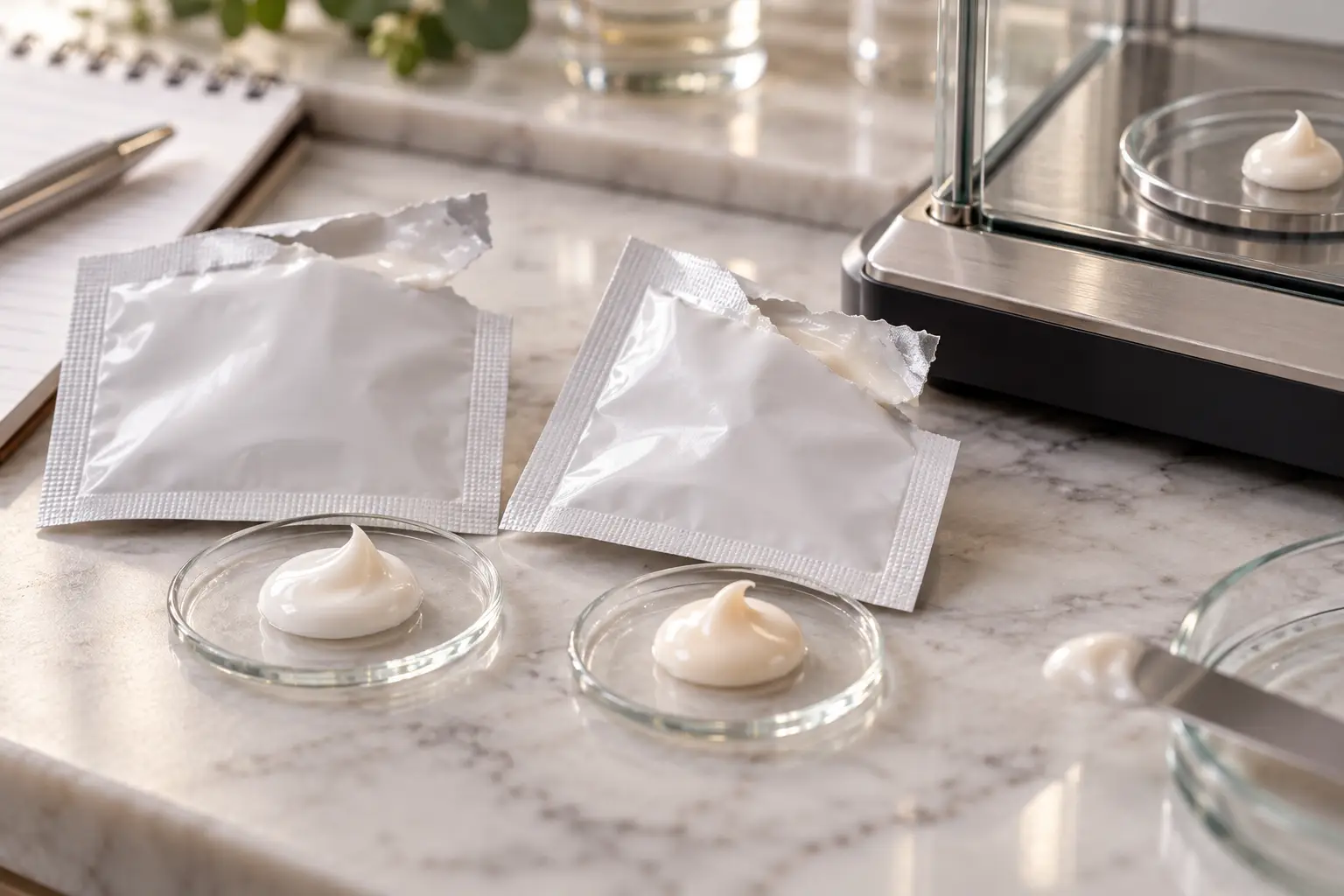
One gram too little can influence the decision your customer makes about your brand.
Suppose you put a cream into a tester sachet. The customer opens it, but there is not enough product for the intended use. Their trial ends before they can properly experience how the cream feels. Filling more than necessary, on the other hand, can increase your sampling costs.
That is why the sachet quantity should not be decided simply by asking, “How many grams should we fill?” You also need to ask, “How will the customer use this product, and how much will they need?”
At Renasan, when evaluating sachet filling for ready-made products, we consider the product’s consistency, intended use and target quantity together.
A tester’s role is not simply to distribute a product, but to give the customer a suitable opportunity to try it.
How should a tester sachet fill quantity be defined?
A tester sachet is designed to let someone experience a product in a particular use scenario. The right fill quantity is therefore not simply a question of how many grams will fit inside the pouch. It depends on where the product is applied, how it is meant to be used, its consistency and whether the sample is expected to support one application or more than one.
A hand cream, a dense treatment product and a fluid lotion may provide very different user experiences at the same weight. Product flow behavior, the ease of squeezing or dispensing from the sachet and the amount left inside the pouch all influence the quantity a customer can actually use. The brand owner, filling partner and packaging supplier should agree on the intended trial before choosing a target weight.
Net fill versus the amount actually available to the user
The mass placed in a sachet may differ from the amount a customer can readily dispense. Viscous or sticky formulations can remain on the inner surface of the pack. Sachet dimensions, opening design and flow properties can all affect how easily the sample is emptied. This makes product-use testing relevant even when the filling equipment delivers a consistent net weight.
Several candidate quantities can be explored under comparable test conditions. The objective is not to maximize fill automatically but to provide enough product for the intended trial while avoiding unnecessary consumption and excessive sample cost.
Factors that influence the target fill
Viscosity influences how a formulation moves during filling and dispensing. Temperature-sensitive products may need further consideration under the proposed production and consumer-use conditions. Product compatibility with packaging materials, the required seal integrity and intended storage period are separate engineering questions that cannot be resolved by adjusting the fill weight alone.
The intended audience also matters. A sample supplied for a single trial may require a different quantity from a sachet intended for several applications. User instructions and product claims must remain consistent with the brand owner’s approved information. Unsupported efficacy claims should not be added simply to make a sample appear more attractive.
A practical fill-quantity assessment table
| Factor | Question | Potential impact |
|---|---|---|
| Application | Where and how will the product be used? | Quantity needed for a representative trial |
| Consistency | Is the formulation fluid or thick? | Filling and dispensing behavior |
| Applications per sample | Is the sachet for one use or several? | Target net fill |
| Packaging | Is the structure compatible with the product? | Testing and approval needs |
| Distribution | How will samples be stored and shipped? | Handling and pack requirements |
| Cost | What is the expected campaign volume? | Cost per sample and material usage |
This table is a decision framework, not a universal weight specification. A defensible number requires information about the particular formulation, package and use case.
How to run a meaningful sample assessment
Define the trial first. Specify the intended application area, whether the pack is single-use and what the customer should be able to experience. Select a small number of plausible fill levels and prepare samples using the same formulation and package configuration where possible. Keeping other conditions comparable makes it easier to understand the role of the fill quantity.
During evaluation, record whether the sachet opens cleanly, how much material can be dispensed, whether the intended application can be completed, how much remains in the pack and whether any leakage or handling issues occur. Judge these observations against criteria agreed in advance rather than relying only on informal impressions. Where required for the formulation, separate stability and package-compatibility testing must also be planned.
Look at the entire sampling cost
Increasing the fill weight usually increases product consumption, but sachet costs also depend on packaging film, printing, line setup, filling losses, cartoning, transport and production volume. A smaller fill could even require a different pouch size or packing configuration, changing material use and processing costs. Compare the full cost per delivered sample with the quality of the experience the customer receives.
Record fill quantity, pouch size, material structure, artwork, labels and carton configuration in a controlled product specification. Our guide to product specifications for repeat orders explains why an approved revision matters, especially for repeat sampling campaigns. A small change in either fill target or package quantity can affect both the production plan and quoted price.
Quality controls during sachet filling
Net fill should be verified using an appropriate measurement method. Sampling frequency and acceptance limits depend on the product, production process and applicable technical requirements; avoid assuming that the same tolerance fits every formulation. Depending on the process, checks may be needed at startup, during the production run and at the end of a batch. Seal integrity, visible leakage, packaging suitability and label accuracy require their own controls beyond fill weight.
When a filling partner handles a formulation supplied by a brand, accurate information transfer is essential. Product identity, storage requirements, target weight, packaging needs, lot traceability and intended use should be clarified before the filling plan is confirmed. A price quotation alone does not provide enough technical information to begin a reliable project.
Frequently asked questions
Is more product always a better sample?
No. The selected quantity should support the intended trial without creating unnecessary material and packaging expense.
How can a fill target be verified?
Combine a suitable weighing or measurement method, documented production checks and practical dispensing trials. The machine setting alone is not sufficient evidence.
Does sachet size determine the fill quantity?
Package geometry matters for seal space and dispensing, but the necessary quantity still depends on the product’s intended use and properties.
In conclusion: Effective tester-sachet filling balances a usable amount of product with packaging suitability, consistent production and campaign economics. Controlled sample testing and written technical approval provide the strongest basis for a final decision.