
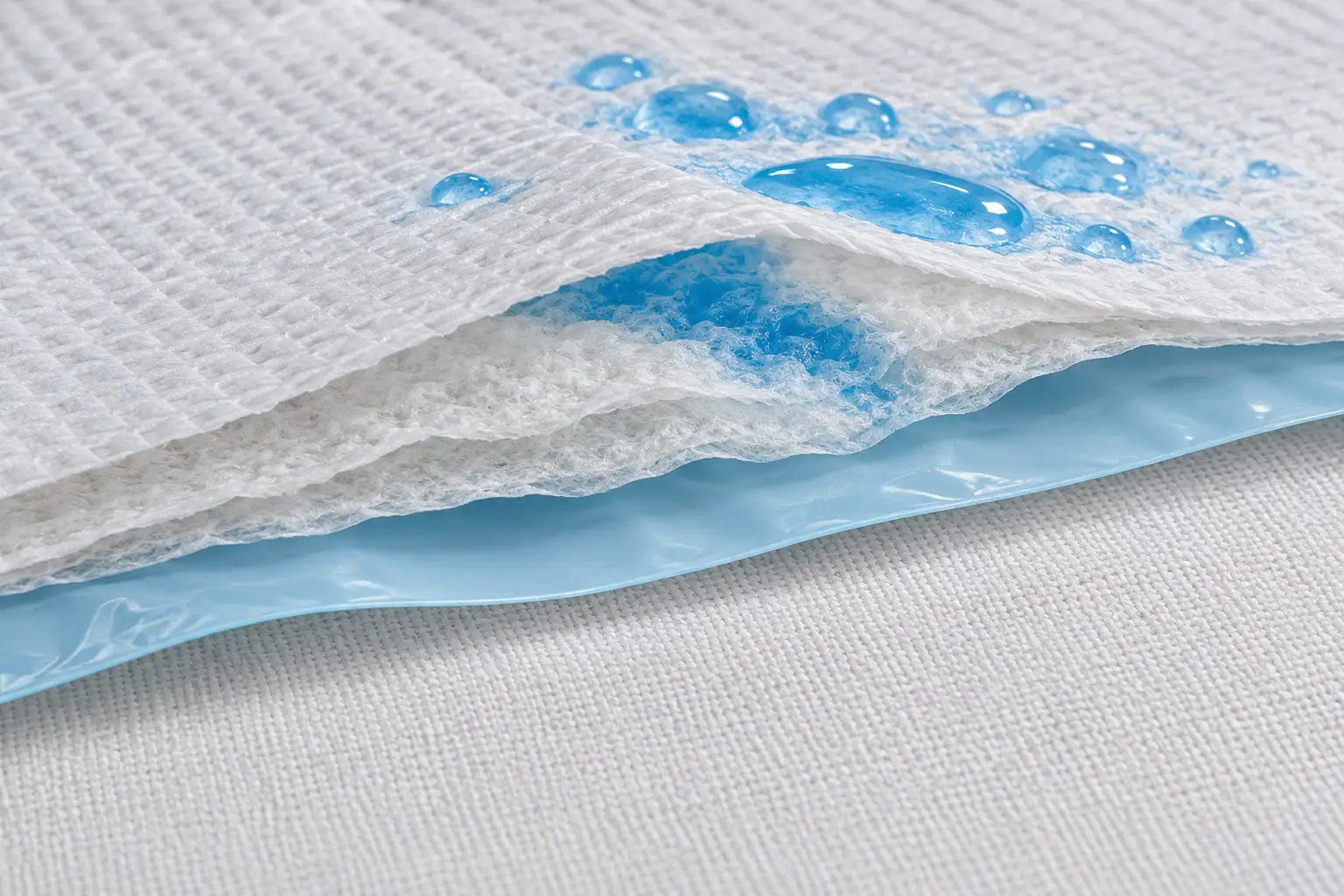
Do not assume that a dental bib protects clothing simply because it absorbs liquid.
Absorbency and a fluid barrier are two different properties. The absorbent upper surface helps retain liquid that lands on it. The barrier in the backing layer serves to limit liquid passing through the bib.
Looking only at the front surface does not fully explain how the product works. When choosing a dental bib, ask not only “How many layers does it have?” but also “What does each layer do?”
At Renasan, when evaluating medical hygiene products, we focus on the function the material needs to perform during use, rather than its appearance.
Not every bib that absorbs liquid protects clothing. Ask about both properties separately when making your selection.
What does absorbency mean in a dental bib?
The absorbent face of a dental patient bib influences how liquid spreads and is retained when it contacts the material during use. Absorbency should not be judged solely by whether the surface appears to soak up water. The amount of liquid, contact duration, rate of uptake and wet-state behavior all matter. Two similar-looking paper or nonwoven surfaces may respond differently under the same conditions.
A small splash during a short procedure is not equivalent to a larger fluid spill. Describe the intended use before assessing whether a particular surface offers suitable absorption. Representative sample comparisons can make these differences clearer than product images or a layer count alone.
What is the job of a fluid barrier?
A fluid barrier is intended to limit liquid passing from the outer surface through to clothing or another protected surface. The ability of a top layer to absorb liquid does not, by itself, establish how well the backing limits strike-through. Absorbency and barrier behavior therefore require separate consideration.
The two functions may be provided by different materials within a composite structure. However, it would be incorrect to assume every dental bib uses the same number of layers, material weight or polymer backing. Ask for the product’s layer construction, intended use and the circumstances under which its relevant performance has been assessed. Different liquids and exposure conditions may produce different results.
Absorbency and barriers compared
| Characteristic | Primary role | Assessment approach |
|---|---|---|
| Absorbency | Help retain liquid on the outer surface | Observe uptake under defined liquid and time conditions |
| Fluid barrier | Limit liquid passing through | Assess strike-through under relevant contact conditions |
| Material integrity | Remain serviceable during handling | Consider tearing and wet-state behavior |
| Dimensions | Cover the intended area | Check fit and positioning in use |
These characteristics complement one another. A highly absorbent top layer may not have a suitable backing, and a material with a barrier may still manage surface liquid poorly. Product selection should therefore consider the combination rather than treating any one property as a complete performance measure.
Does the number of layers determine quality?
Descriptions such as “two-ply” or “three-ply” provide some information about construction, but not a full account of performance. The role and material of each layer, its bonding method, thickness and use conditions also matter. A composite bib may combine absorption and barrier functions, yet those functions cannot be established reliably from the layer names alone.
Procurement specifications should describe the required function as well as the construction. If a particular level of fluid resistance is needed, the relevant acceptance or verification approach should be agreed. Any medical or protective performance claim must match the item’s actual intended use and applicable requirements.
Consider the real dental-clinic use case
Patient positioning, bib size, procedure duration and expected fluid exposure help determine whether a product is suitable. A bib placed over clothing does a different job from a disposable cover placed on a dental tray. Ease of placement, fastening and adequate coverage can all affect performance even when the materials look similar.
Define the setting: Which type of procedure is involved? Is the product required for short or extended use? Is exposure primarily occasional splashes or more continuous moisture? These questions help focus sample evaluation on the relevant properties. A similar practical approach is described in our article on examination table cover performance.
How to compare samples fairly
When assessing different bib materials, use comparable liquid types, quantities, contact times and handling conditions. Observe the uptake of liquid, whether moisture appears on the backing, whether layers separate, and how the material behaves when wet. A simple informal splash demonstration may help form an initial impression, but it cannot substitute for any necessary technical or regulatory testing.
Identify each sample by product code and specification revision. Record the approved dimensions, material construction and packaging. Our guide on repeat-order specification controls explains why these details must remain consistent when another batch is purchased.
Packaging and storage considerations
Pack quantities, folding arrangements, carton configuration and protection from unsuitable storage conditions can all affect convenience at the point of use. Follow any specified storage instructions. Items with compromised packaging should be handled under the organization’s quality procedures rather than automatically being assumed suitable. Performance needs to be protected from manufacture through to use.
A procurement checklist for dental bibs
- State the intended application and likely fluid exposure.
- Ask separately about surface absorbency and backing behavior.
- Check dimensions on the actual patient-use area.
- Request appropriate evidence for relevant technical claims.
- Record the identity and revision of approved samples.
- Confirm pack quantities, carton arrangements and storage requirements.
Frequently asked questions
Does an absorbent bib necessarily protect clothing?
No. Surface absorption and limiting liquid transfer through the backing are different functions and should be considered separately.
Does adding more layers always improve fluid resistance?
No. Material selection, layer integrity and use conditions are essential. Layer count alone does not establish barrier performance.
Can a photograph confirm a dental bib’s suitability?
A photograph may show its appearance and shape, but not reliably demonstrate absorbency, strike-through behavior or comfort in use.
In conclusion: Choosing a dental bib requires understanding the distinct roles of the absorbent top surface and fluid-barrier backing, then evaluating both against the actual clinical workflow and product requirements.