
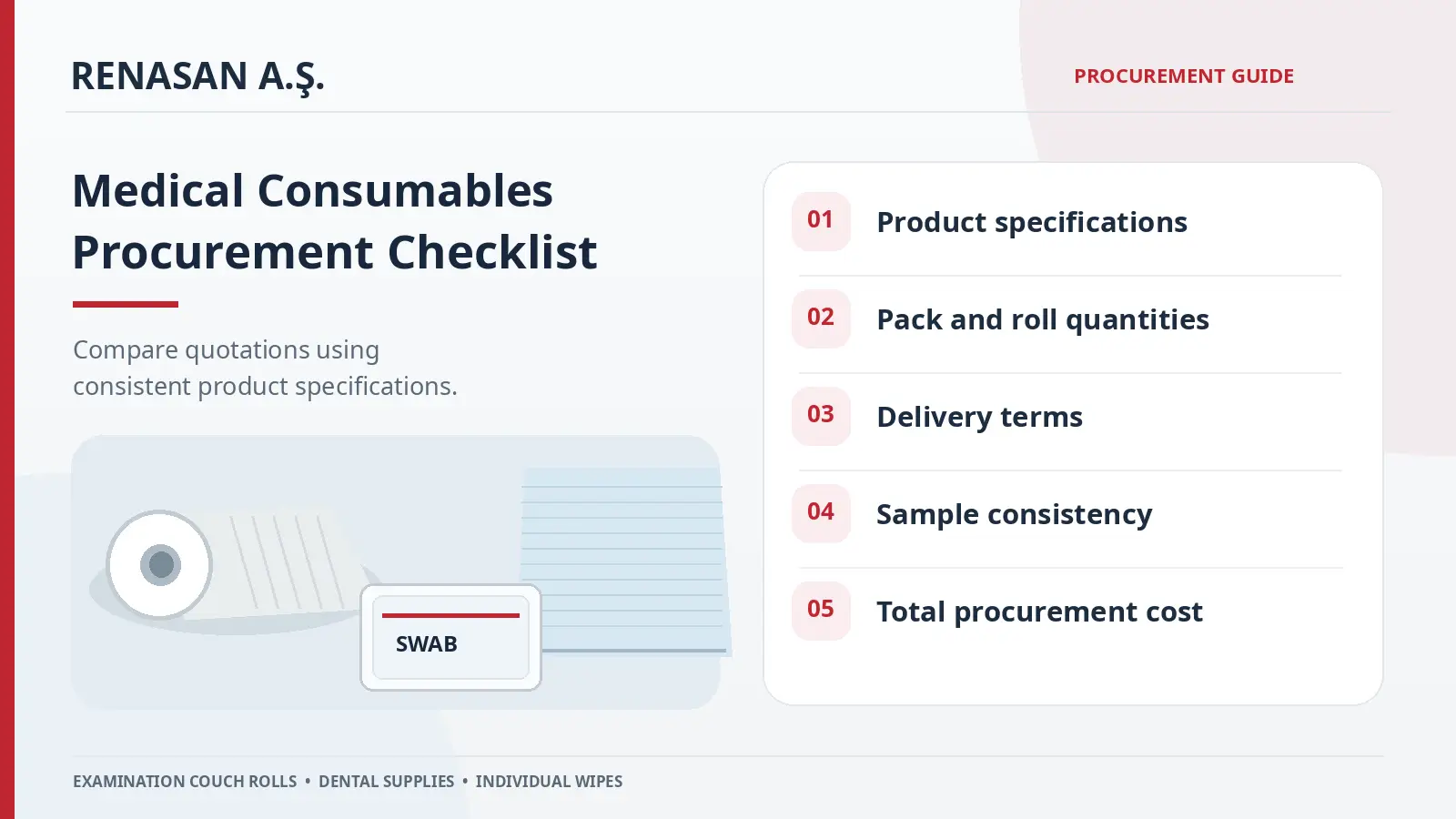
For regularly purchased consumables such as examination table covers, dental bibs and individually packed wipes, procurement decisions should go beyond the quoted unit price. Technical specifications, pack quantities, delivery arrangements and repeat-order requirements all influence the total cost of supply.
1. Define the product specification
Before requesting quotations, specify the required width, length, number of plies, paper basis weight, lamination structure where applicable, and packaging format. Products with similar names can have different specifications, making direct price comparisons misleading.
2. Compare prices on the same unit basis
Two roll prices may look similar even when roll lengths or carton quantities differ. Compare the cost per metre, sheet or usable unit, whichever best represents your purchasing requirements.
3. Clarify delivery and repeat orders
Share estimated consumption, delivery frequency and packing requirements. Ask the supplier to confirm production and delivery arrangements in writing, especially for recurring orders.
4. Review samples and consistency
For a new supplier, compare samples with the agreed specification. Record the required product characteristics in purchase orders so that subsequent deliveries can be assessed against the same criteria.
5. Evaluate total procurement cost
Consider freight, storage, packaging and potential waste alongside the purchase price. The lowest quoted price per unit is not necessarily the lowest overall procurement cost.
Request a specification-based quotation from RENASAN
RENASAN A.Ş. manufactures and supplies examination table covers, dental consumables and individually packed wipes from Ankara, Türkiye. Send your required dimensions, specifications and estimated quantities to request a comparable manufacturer quotation.
Explore our examination table cover range or visit RENASAN to get in touch.
Why technical suitability comes first
Disposable medical and hygiene consumables may be marketed under similar names while serving different applications. Before requesting quotations, a purchasing team should confirm where and how each item will be used and define the characteristics that matter most. Roll dimensions and construction may be central to an examination table cover, while absorbency and fluid-barrier behavior may need separate consideration for a dental bib.
A broad product name in a request can produce quotations that are difficult to compare. Include units for all dimensions, relevant layer construction, pack contents, intended use and applicable labeling requirements. Any requested certificates or tests should be appropriate to the exact product and its classification rather than assumed identical across all consumables.
Check 1: Standardize the specification
Collect the clinical or operational user’s requirements in a controlled product record. Include the product code, dimensions, material structure, location of use, packaging details and approved sample or drawing where applicable. All suppliers should receive the same version. If a supplier proposes an alternative, ask for the compliant quotation and the alternative to be identified separately.
For repeated purchases, rely on an approved version rather than reconstructing requirements from previous emails. Our guide to repeat-order specification control explains how revision tracking reduces confusion when packaging or dimensions change.
Check 2: Compare prices in consistent units
One manufacturer may quote per roll and another per carton. If widths, lengths or carton contents differ, headline prices are not comparable. Depending on the item, costs per metre, square metre, piece or pack may provide a better comparison. However, the selected numerical unit should not conceal important technical differences.
For example, do not compare a 50-metre roll with a 100-metre roll solely by the price of each roll. Actual use efficiency can vary. Our article about examination table cover performance explains why coverage and handling characteristics matter alongside stated dimensions.
Check 3: Evaluate lead times and supply continuity
Competitive pricing has limited value if deliveries cannot meet the operational requirement. Track actual time from placing an order to accepted receipt, and review variation as well as averages. For regularly used products, agree how forecast volumes, staged deliveries and possible delays will be communicated.
Inventory planning should connect the consumption rate with the replenishment lead time. The principles in our reorder-point and safety-stock guide provide a useful framework. Procurement and warehouse teams should share accurate data rather than making separate assumptions.
Check 4: Review samples against defined criteria
A representative sample can reduce uncertainty when selecting a new supplier. Assess dimensions, packaging, material behavior and ease of use against the approved requirements. For characteristics such as fluid resistance, an informal visual test may not be enough; determine what appropriate technical evidence is necessary.
Register the approved sample’s product code and revision. Reference the same information in purchasing documents, and ensure later deliveries can be assessed consistently. A sample that is never linked to an order or receiving procedure offers limited long-term value.
Check 5: Assess total procurement cost
Unit price is only one part of purchasing economics. Freight, storage, order frequency, waste from unsuitable products and excess inventory may alter total costs. Ordering more than needed to obtain a lower carton rate can tie up space and funds. Where appropriate, cost per realistic use should also be considered.
The objective is not always the lowest visible price but a combination of appropriate specifications, viable replenishment and reasonable total cost. Both immediate and longer-term effects should be weighed in a documented decision.
A supplier evaluation table
| Criteria | Evidence | Risk if ignored |
|---|---|---|
| Technical suitability | Approved product code and sample | Incorrect material |
| Comparison unit | Piece, length or area | Misleading cost comparison |
| Lead time | Delivery history | Stock interruption |
| Consistency | Controlled specification version | Different repeat-order product |
| Total cost | Purchase, logistics and stock effects | Hidden operating expense |
Adjust the relative weight of these criteria to the application. For critical consumables, suitability and continuity may deserve greater emphasis than minor unit-price differences.
Information to include in a quotation request
- Product name, code and intended use
- Critical dimensions, construction and pack details
- Expected annual consumption and initial quantity
- Delivery frequency, destination and timing
- Sample and acceptance requirements
- The unit in which offers should be compared
Frequently asked questions
Why might the lowest quote not be preferred?
Specifications, pack quantities, delivery scope and real use efficiency can differ. Total cost and technical suitability should be considered together.
How should a new supplier be evaluated?
Depending on the product, start with representative samples and appropriate checks, then monitor actual delivery performance against the agreed requirements.
Must a specification be rewritten for every repeat order?
No. An approved version can be reused when still valid, with any changes handled through revision control.
Conclusion: Five core medical-consumables procurement checks are technical clarity, fair unit comparison, lead-time reliability, sample consistency and real total cost. Together they support better evidence-based purchasing decisions.